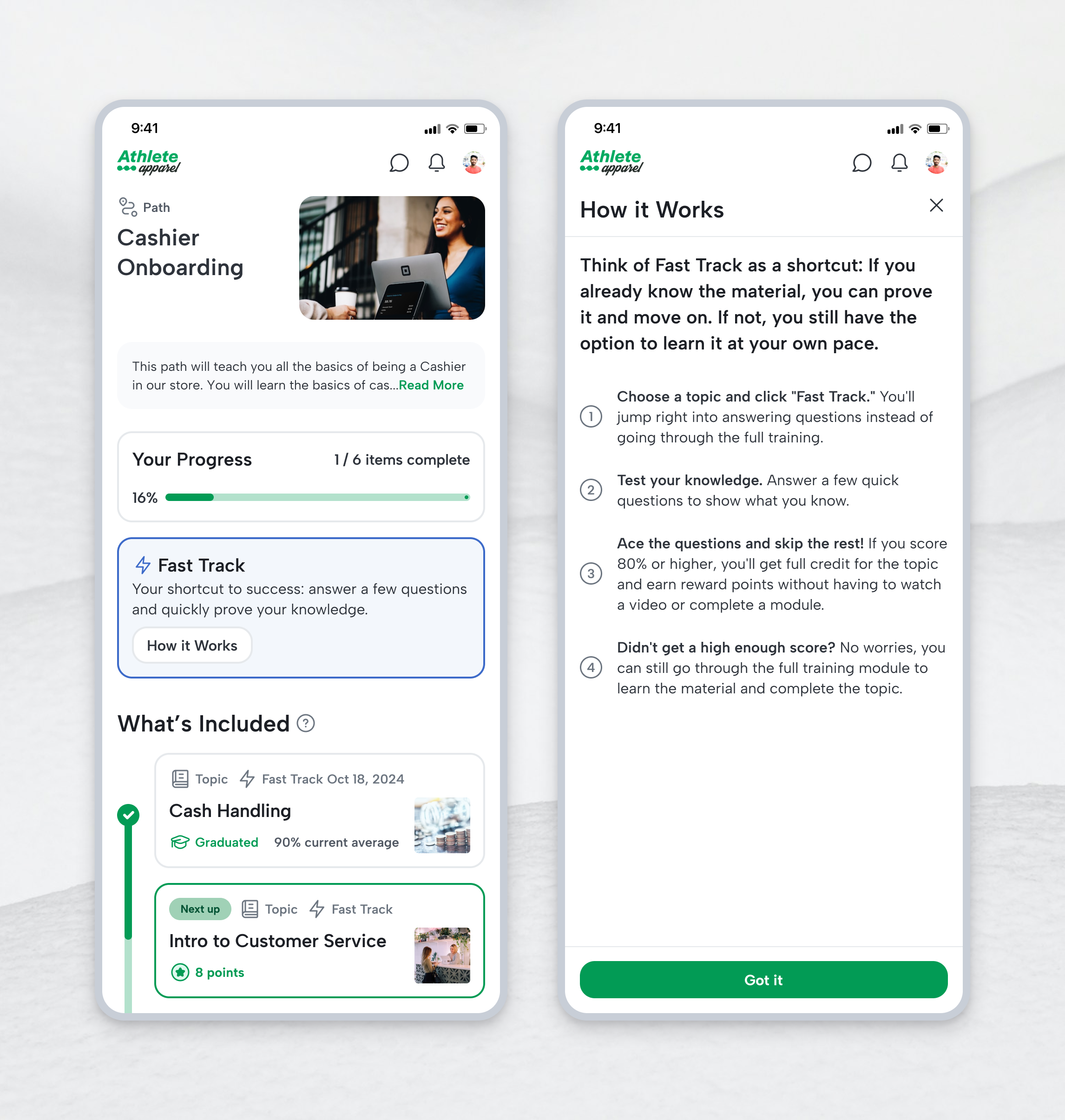
Fast Track
Empowering frontline users to complete training efficiently, enabling knowledge growth and measurable business results
The challenge
Accelerate the time-to-productivity for frontline associates without compromising the quality of their training. Traditional, lengthy training modules were creating friction for both the business and employees.
Pain points
Organizations need to quickly onboard new hires while maintaining confidence that associates are fully prepared, and lengthy training cycles increase time-to-productivity and administrative costs.
Long-tenured employees often feel demotivated about the redundancy when expected to repeat familiar training.
Customers need assurance that our approach could reliably cover all essential knowledge, including complex, company-specific information like brand standards and culture.
PROPOSED SOLUTION
A feature that enables frontline associates to answer just a few questions and test their knowledge. Our system then assesses the user’s competency to determine if they need to take the full training or not, reducing time needed without sacrificing knowledge retention.
THE IMPACT
Empower frontline associates to have control over their learning journey, while saving organizations valuable time and money on training hours.
HOW’D WE GET HERE?
My design process
My primary goal was to design a simple, trustworthy, and effective experience. I partnered with my product manager and engineering counterparts to define the initial concept and then led the UX research and iterations.
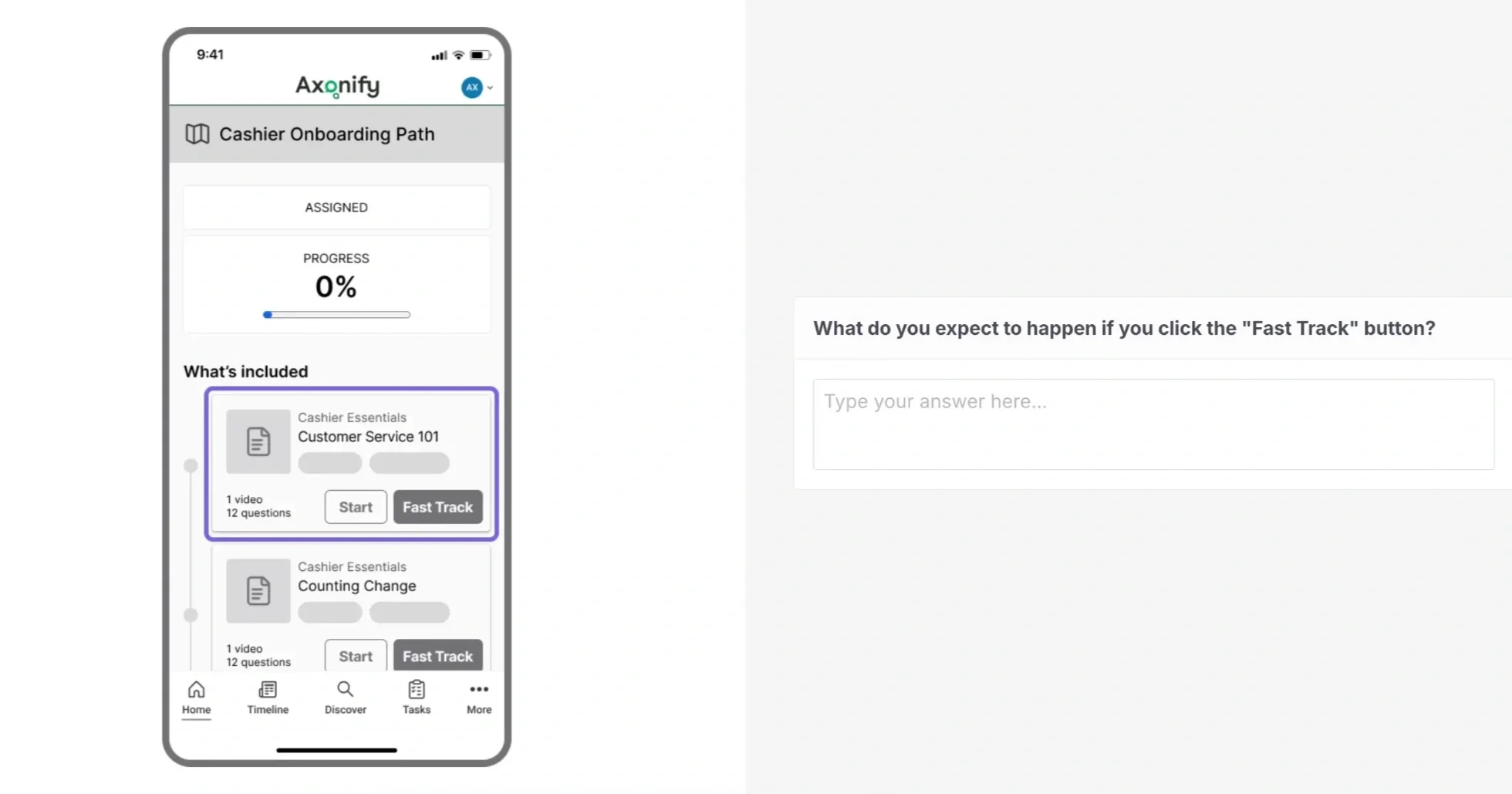
To assess the concept's clarity and usability, I designed a low-fidelity prototype and deployed a survey to our target users: frontline associates.
01 — Setup
I collaborated with one of our grocery customers to distribute the survey, gathering insights from over 320 frontline associates.
02 — Synthesize
Both quantitative frontline survey responses and qualitative feedback from interviews with administrators to get insights on both sides of the user experience.
03 — Sentiment
60% of participants expressed a positive desire to use the feature. This confirmed that the initial design was well understood, felt usable, and resonated with users.
Iterating on feedback
Common user concerns that arose in research interviews and surveys revealed two main areas where the design needed strengthening to ensure user trust:
-
Design Action: I added a "How it Works" modal before the entry point of any Fast Track-enabled path.
Rationale: My initial design lacked a simple explanation for first-time users. The modal clearly communicates the feature's purpose and benefits, building user confidence which safeguards the training integrity. Providing Admin flexibility ensures that customers can strategically apply the feature only where knowledge assurance is high (e.g. non-compliance topics).
-
Design Action: I ensured the underlying logic always directs the user to the full training if the knowledge check is failed. I also enhanced the Admin setup to allow for more granular control, enabling the targeting of Fast Track to specific topics or user groups.
Rationale: This safeguards the training integrity. Providing Admin flexibility ensures that customers can strategically apply the feature only where knowledge assurance is high (e.g. non-compliance topics).
RESULTS AND REFLECTIONS
Where we ended up
I finalized the design with these user-informed changes before a collaborative handoff, saving development time and cost.
We also put Fast Track through an Early Access Program (EAP) before launch for some early customer usage. One customer had over 1,000 Fast Track completions in the first two weeks, and another expressed high confidence that the feature will be key to getting employees on the floor faster.
After continuing to iterate on the Fast Track experience in partnership with product and engineering, it successfully launched in late 2025.
With Fast Track, customers are seeing 4x faster onboarding, 76% lower training labour costs, and in general their frontline associates are on the floor faster.