Frontline Skills
Validating and visualizing employee abilities to help businesses, administrators and individuals succeed
The challenge
For many frontline employees, like those in manufacturing or retail, validating and visualizing skills is a complex and high-value problem. My goal with the Frontline Skills project was to tackle this challenge by determining which aspects of the "skills" problem to prioritize.
HOW’D WE GET HERE?
My design process
As a Product Designer, I worked to understand the challenges surrounding employee skills and create a solution that would benefit managers, administrators, and the employees themselves.
01 — Understand
Led customer interviews and conceptual walkthroughs to understand user pain points in detail. I created an affinity map with my PM to synthesize findings and gather actionable insights.
02 — Define
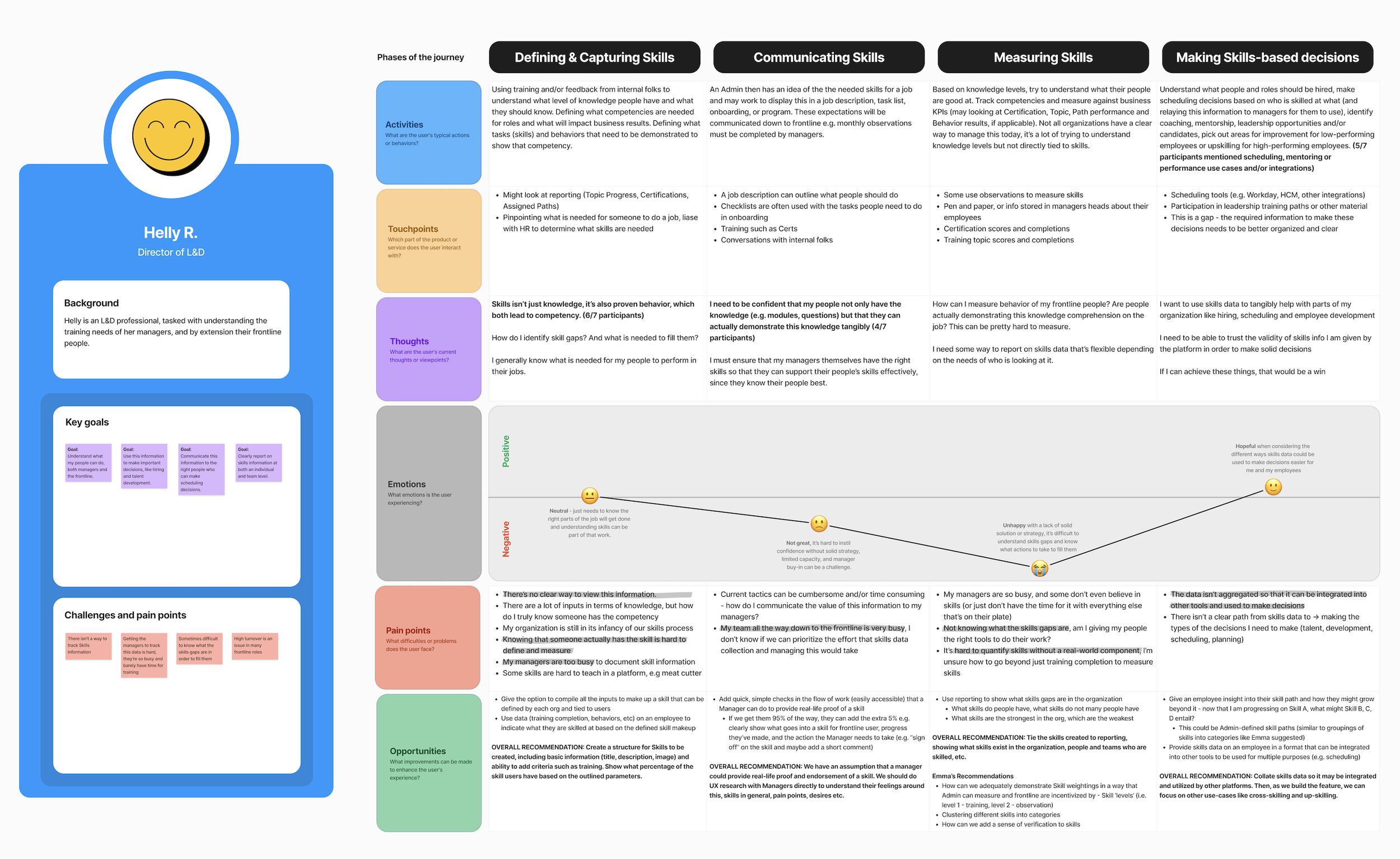
Developed a user journey map to visualize user experience and guide our initial design concepts. Defined the core of the skills feature, prioritized which parts of the problem to solve, and identified the right problems through UX research.
03 — Conceptualize
Translated user needs into a concrete product direction and initial design concepts for a viable V1 and a future vision.
Pain points
My research showed that users needed more than just a list of who has a skill; they needed to understand how skilled someone was. The key pain points I uncovered were:
There was a need for a real-world component to validate that a person truly possessed the abilities to perform their job well.
Administrators lacked clear, aggregated skills data, which made it difficult to make informed decisions about hiring, development, scheduling, and workforce planning.
Users struggled to understand what problems their skills information could help them solve and how to grow their skills.
PROPOSED SOLUTION
We were operating in a highly saturated solution space with many potential avenues, and it was my job to make sense of this ambiguity. I focused on prioritizing the right problems we identified through UX research, rather than trying to solve everything at once.
The proposed concept was an AI-powered Skills solution that would allow administrators to easily create skills from existing learning assets, enabling frontline employees to track their progress.
THE PIVOT
A change in team strategy meant this project didn’t continue past the initial discovery and iteration phases.
I believe this was the right decision, because the core problem we identified was more complex than our initial assumptions. Our research showed that to provide meaningful value we’d require significant resources that we didn’t possess at the time.
My research was instrumental in helping the team make this difficult but necessary decision.
RESULTS AND REFLECTIONS
Where we ended up
The insights from our research allowed us to move from a broad problem space to a focused, viable solution; translating user needs into a concrete product direction and initial design concepts. The refined understanding of our users' problems enabled us to outline detailed requirements and design approaches for a truly impactful V1 and future vision.
While the project didn't result in a launched product, the insights from our research were still highly impactful.
This project highlighted the importance of using design to inform and influence product strategy, even when it leads to a strategic pivot.